
The financial services landscape is changing at an unprecedented pace. With continued volatility, investment managers are increasingly being pushed to diversify portfolios.
This evolution presents a unique challenge for those responsible for client communications. Explaining complex shifts in strategy, and helping clients understand why these changes are necessary, has never been more important or more difficult.
At the same time, advisers and communication teams operate in an environment dominated by technology. Digital tools, AI and data analytics can simplify processes and create efficiencies, yet they also bring complications.
Information is everywhere, but not all of it is useful. Filtering signal from noise has become a critical skill. “We are constantly bombarded with information, misinformation, disinformation, propaganda,” says James Amy, business development manager at Orbis Investments, highlighting the sheer volume of content that advisers and clients alike must navigate.
“In an investment environment, it’s really about focusing on the pieces of information that are actually going to help us make better investment decisions.”
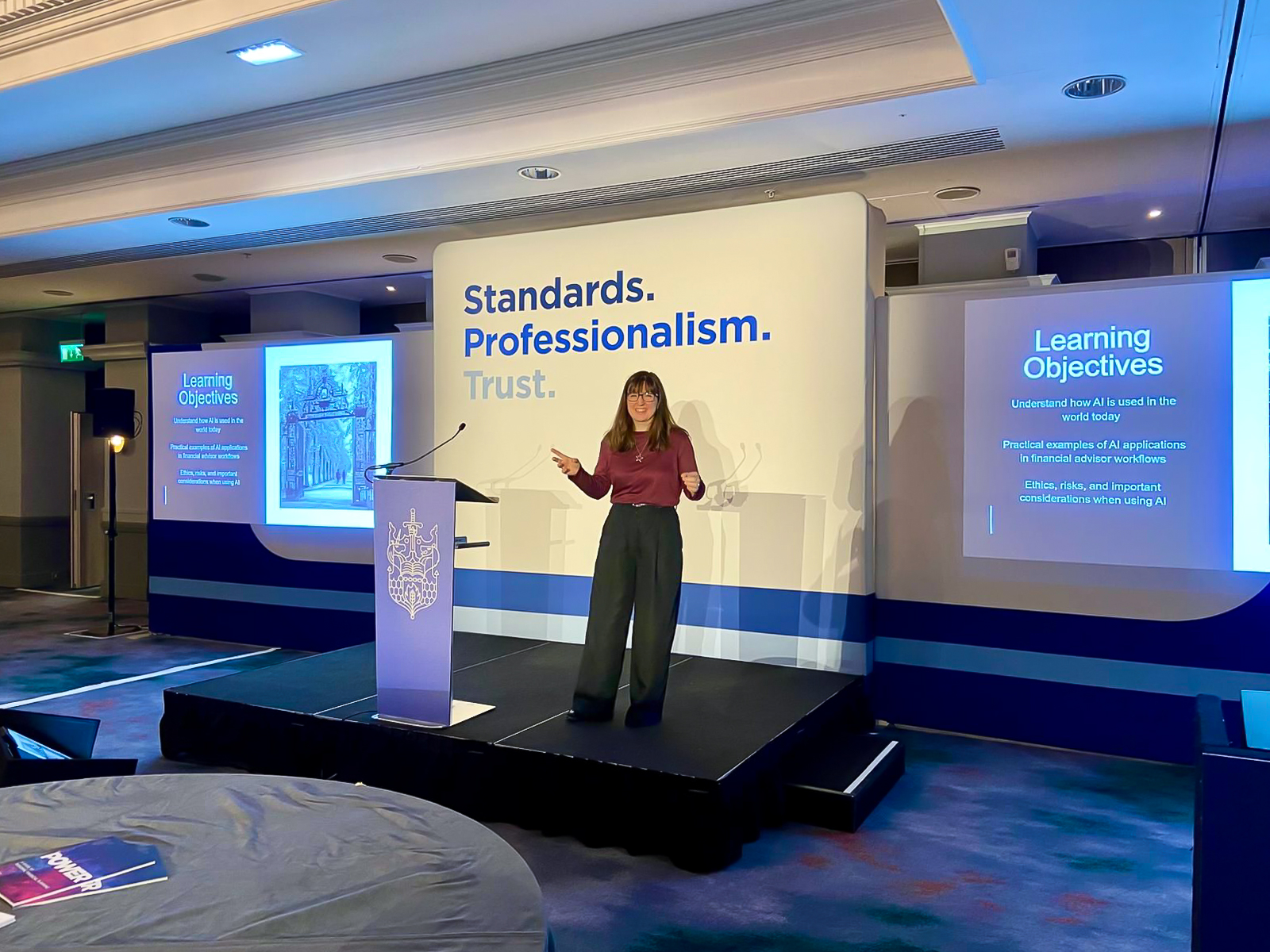
At the Personal Finance Society’s Autumn Roadshow in Brighton, experts discussed how this dual challenge of translating complex financial strategies and managing the flood of digital information has forced communicators to rethink their approach.
Smarter communication
Communicating complex subjects in a way that is simple and digestible remains one of the biggest challenges for communication strategies, says Dr. Catherine Breslin, an AI consultant.
“In the financial services world, there are a lot of complex concepts clients don’t always understand,” she says. “I would read a lot of your documents and get lost in the vocabulary and terminology”.
This is where AI can play a powerful role, she says. One notable example comes from the ACA, where teams have been experimenting with large language models (LLMs) to test whether they could simplify financial language without compromising accuracy.
“They were looking at whether they could use LLMs to create simplified definitions of financial concepts that were easy enough for clients to understand but also accurate,” she explains.
In a sector where clarity and accuracy are critical, AI’s ability to translate complex material into accessible language can help firms build stronger, more meaningful relationships with clients.
This potential extends beyond client education. Breslin explains that AI’s capacity to process, summarise and generate text has significant implications for the way organisations approach marketing and content creation.
Tasks such as drafting emails, researching clients, preparing proposals, reviewing meeting notes and producing social media content can all be accelerated through automation. However, she stresses, the technology should be regarded as an assistant rather than a replacement.
“It’s very easy to sit there and say ‘AI write me a LinkedIn post on a report that was out last week’. But what you’ll get back from the AI will be bland and generic and won’t have your voice, perspective and insight,” she explains.
Instead, she recommends using AI as a creative partner that can help refine, rather than replace, human communication.
“I’ll try and write a decent draft and then put it into the AI model and say ‘can you critique this? Tell me what’s wrong with it. This is the audience’,” she says. “It will be really good sometimes at coming up with ways of changing and making it better.”
By combining human insight with AI’s analytical capabilities, she adds, content can be produced faster and more efficient to create but also more resonant and precise.
This blended approach ensures that clarity and personal perspective remain at the heart of communication to preserve the human voice while harnessing the power of technology to enhance it.
The power of the human touch
Keeping the human element at the centre of communication strategies is of utmost importance. John Whitehead, founder and principal of Future-in-sight, stresses that while technology can deliver vast quantities of data, effective communication should focus on creating a personal story rather than presenting numbers.
This is particularly important in financial planning because clients’ lives and experiences are constantly evolving, he says.
“Communicating a different language is the single biggest takeaway. Storytelling is more powerful than presenting. Get them [clients] engaged in the story, they are the authors and the stars of each new chapter.”
Hugo White, business development manager at Timeline, echoes the view that building relationships relies more on personal connection than on data or analytics.
“The key drivers of a relationship with a financial adviser are not the metrics that some advisers may push to the front of their valuable positions,” he says. “It’s none of the technical, mathematical, analytical areas of what we provide to our clients, it’s really down to the more connection based.”
White also emphasises the importance of human connection, highlighting how as technology transforms the mechanics of financial advice, the competitive edge lies in how advisers communicate.
He describes the rise of the “superhuman adviser,” which refers to a professional who combines the efficiency of digital tools with the empathy, intuition and understanding that only a human can provide.
In a world increasingly shaped by automation, this hybrid model allows advisers to maintain trust and build relationships in ways that data or algorithms alone cannot achieve.
This is why it’s important for humans to work in harmony with AI rather than relying on it entirely, according to White.
“We don’t believe that we’re seeing that the advisors can be replaced. It’s more redefining the value propositions that advisers provide to their clients,” he says, adding that as AI evolves.
However, he warns that AI can introduce challenges, including inconsistent outputs, fragmented data and high costs. Therefore, personal engagement remains essential to mitigate these risks and ensure clients feel genuinely understood.
Ultimately, both Whitehead and White emphasise the same principle that technology can transform the delivery of information, but the human elements of communication, such as storytelling, empathy and trust, remain the foundation of lasting client relationships.
By blending human insight with AI efficiency, financial advisers and marketers alike can create experiences that are both intelligent and personal.