
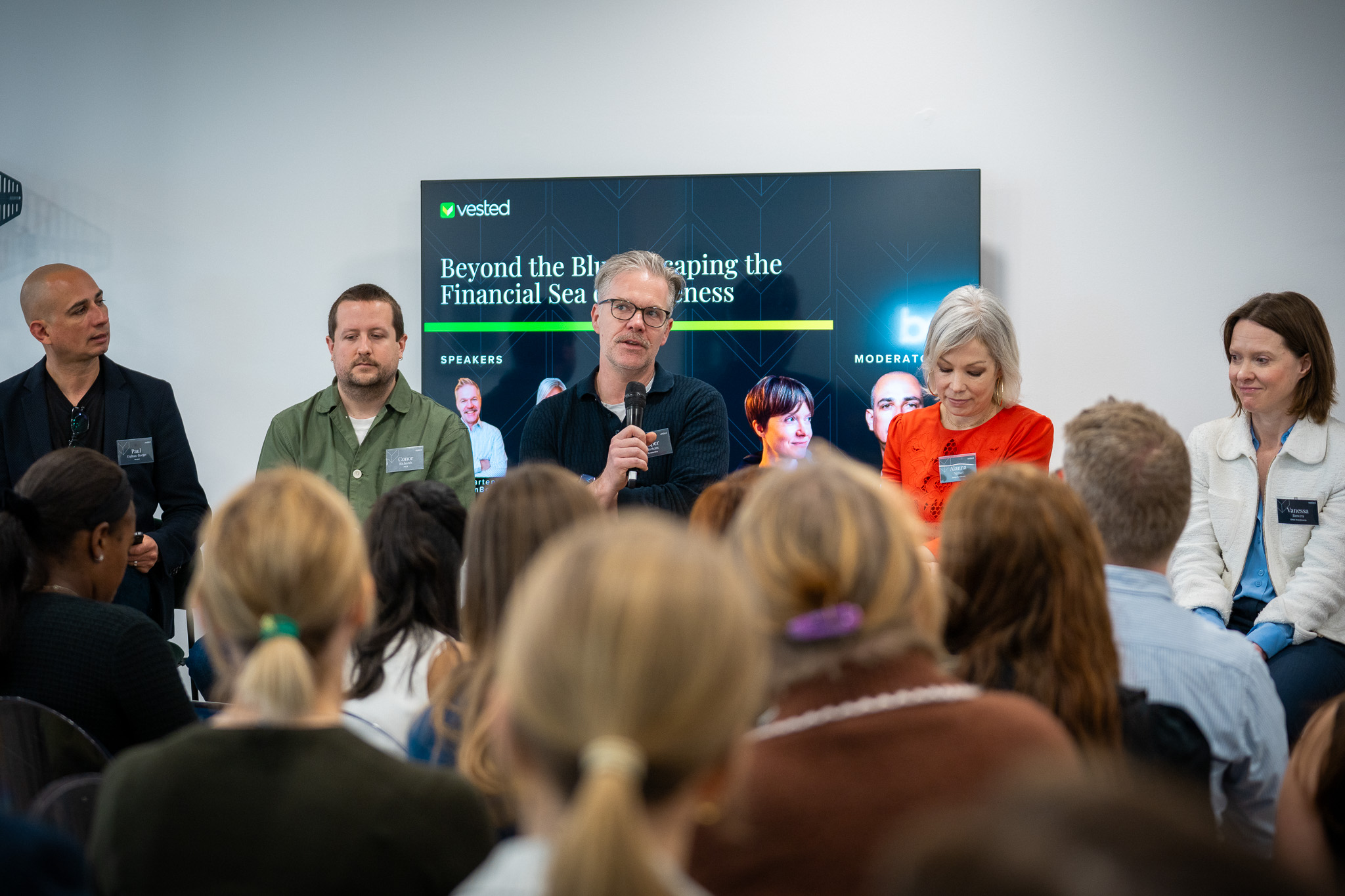
Financial marketers say AI is accelerating the industry’s long‑running drift toward look‑alike branding, but argue the same shift is creating a rare moment for firms to reset how they differentiate, communicate and reach out to customers.
Speaking at closed panel session, hosted by Vested, senior leaders said the issue is no longer just a creative problem but a structural one, shaped by regulation, globalised tech stacks, compliance‑led messaging – and now AI‑mediated discovery.
Sameness is now structural — and AI is amplifying it
PensionBee CMO Jasper Martens said the industry’s convergence has been visible for years. “Everybody has an app, everything is simple, everything is easy to use,” he said. “If you swapped the colours on half the ads on the District Line, you wouldn’t know whose was whose.”
He warned that AI‑generated content risks deepening that interchangeability unless brands “double down on what actually makes them different”.
Janus Henderson Investors’ global head of brand Alanna Nensel agreed, arguing that sameness is no longer just aesthetic.
“It’s not just similarity anymore — it’s almost interchangeability,” she said. “With AEO, you’re now marketing to machines that decide what humans see.”
She said brands must now optimise for discoverability and citations, because AI systems increasingly rely on third‑party sources rather than corporate websites.
“If you’re not in that AI‑generated answer at the top of search, you might never be seen,” said Nensel.
The opportunity: clarity, consistency and human connection
Orbis Investments’ head of UK marketing Vanessa Bowen said the real risk was not boldness but invisibility. She argued that differentiation must start with the business model — in Orbis’s case, its performance‑linked fee structure — and then be expressed relentlessly.
“The biggest risk is being forgettable,” she said. “Memorability comes from being true to what you deliver and being consistent every single day, even when the sales team wants something broader or safer.”
For the Financial Services Compensation Scheme’s (FSCS) head of brand Conor Richards, AI is now a live part of creative development, but authenticity still matters.
“People are so sensitive to seeing AI in advertising,” he said. “It can be more damaging to the brand than the cost you save. The last thing you want is an ad where someone has six fingers.” Indeed, when FSCS explored AI‑assisted production for its recent deposit‑limit campaign, consumer perception became the deciding factor.
AI may make human‑centred brands more valuable
Yet, Martens said the rise of AI could actually increase the value of human‑centred brand experiences. PensionBee’s ‘beekeepers’ — real people customers can call — are becoming a more important differentiator as automation grows.
“When lots of things are AI‑generated, the human touch becomes more important,” he said. “Credible humans will matter more.”
He said the firm is even exploring physical “beehives” on the high street to give customers face‑to‑face support — a counter‑trend to digital sameness.
A moment for brands to choose who they want to be
Across the panel, the message was consistent: AI is raising the stakes for clarity, credibility and distinctiveness, but marketing and comms professionals needed to stay in control and across the business strategy for it to work.
“If you know who you are, who you’re for, and what you don’t do — that’s what cuts through,” said Bowen.
Nensel added success will come for brands that treat AI a tool or function rather than just a short cut.
“This is the moment to be really clear about what you stand for — because the machines are watching too,” she said.
Beyond the Blue: Escaping the Financial Sea of Sameness was a panel hosted by Vested. Subscribe for more coverage in FP Voices over the coming weeks.
PensionBee is shortlisted for the inaugural FP Awards USA, which take place on June 18 in New York City.