
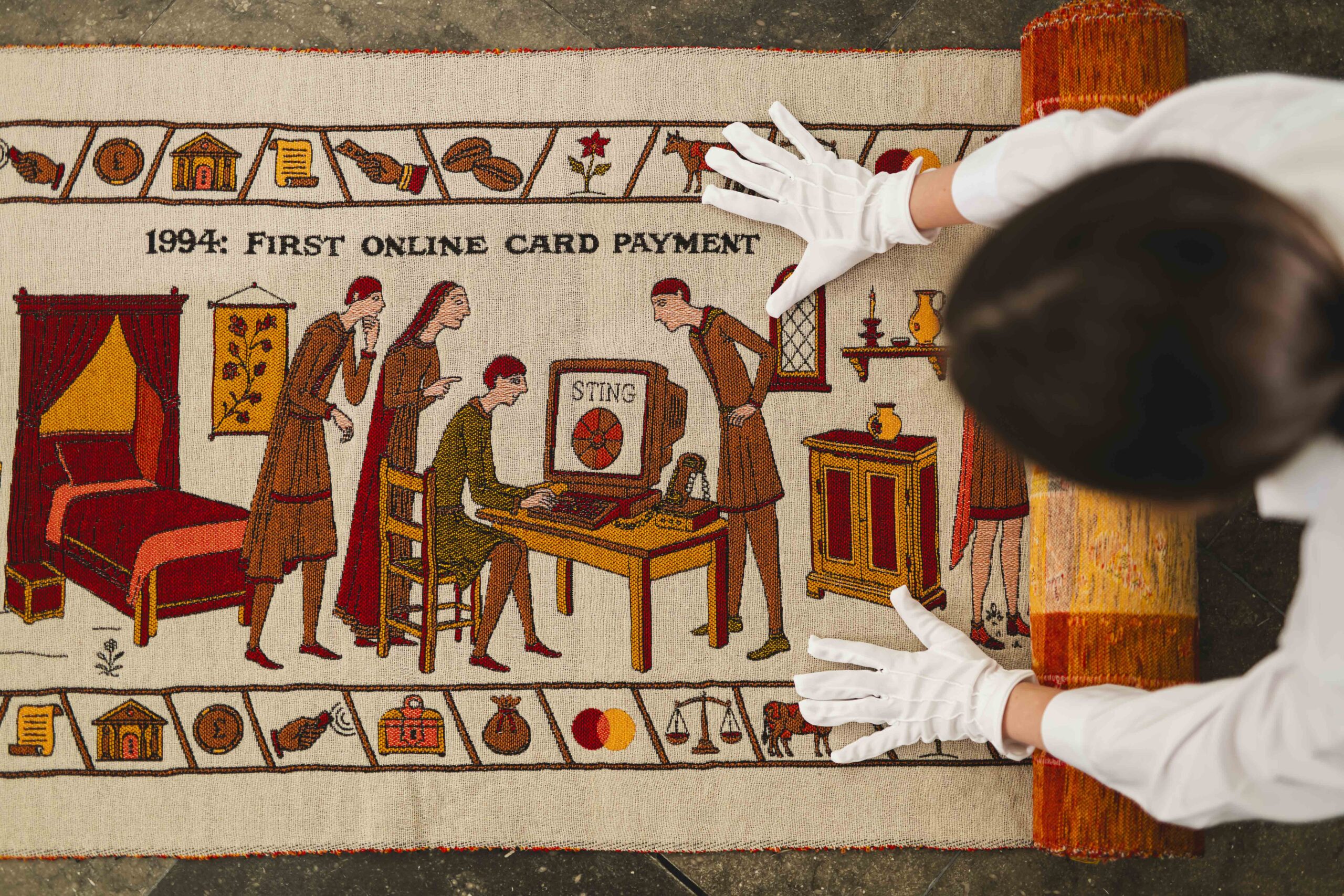
Mastercard has unveiled the ‘Payeux Tapestry’, a 10-metre-long artwork tracing the history of shopping and payments from ancient currencies to the future of AI-powered commerce.
Created to coincide with the return of the Bayeux Tapestry to England, the installation depicts 15 key moments in the evolution of commerce, from cowrie shells and coins to contactless payments, digital wallets and agentic AI.
The project was directed by tapestry artist Mia Hansson and brought to life using illustrations created by children, requiring more than 200 hours of weaving and almost 35,000 passes of a jacquard loom.
The final scenes look ahead to 2030, illustrating predictions from leading futurists on how artificial intelligence could transform shopping and payments. Scenarios include AI assistants making purchases on behalf of consumers, smart appliances ordering household essentials and robots completing shopping tasks within pre-set budgets.
The artwork accompanies Mastercard’s new report, A Short History of the Future of Shopping and Payments, which explores how emerging technologies could reshape consumer behaviour over the coming decade.
Simon Forbes, President of Mastercard UK & Ireland, said AI could represent one of the most significant shifts in shopping for decades, with consumers increasingly relying on technology to help make purchasing decisions.