
For much of the past month, the sporting world has revolved around football.
Marketing departments have chased World Cup engagement. Brands have scrambled to align themselves with England’s progress. LinkedIn feeds have filled with football content. And now, following England’s semi-final exit, many sponsors will be reassessing where they focus their sporting attention next. They might do well to look north.
While the World Cup has dominated conversations and budgets, the smart money has been flowing to Glasgow 2026 which has been quietly assembling a fascinating roster of financial services, insurance and professional services backers.
With financial services budgets under pressure and marketers being told to reinforce brand but also produce ROI, the Commonwealth Games and their emerging athletes, offer a tantalising prospect of major above-the-line visibility at a fraction of Olympic prices.
There is a but…
In truth, the Commies are not the Olympics. They are not the World Cup. They do not command the same global audiences, sponsorship revenues or superstar athletes.
The Glasgow Games themselves emerged from unusual circumstances after the withdrawal of Victoria as host, forcing Commonwealth Sport to develop a leaner, more sustainable model built around existing venues and a reduced programme.
Organisers have openly presented Glasgow 2026 as a blueprint for how major sporting events can be delivered more efficiently in the future. Yet despite recurring questions about the event’s future, the sponsors keep arriving.
One of the more revealing aspects of Glasgow 2026 is the calibre of financial services and insurance organisations attaching themselves to the Games, national teams and Commonwealth athletes.
Bupa has become the Official Healthcare Principal Partner of Glasgow 2026, an official partner of Team Scotland and a supporter of Commonwealth Sport’s GAPS programme, which helps emerging Para-athletes across the Commonwealth.
ASB Bank is supporting New Zealand’s pathway to Glasgow through partnerships with the New Zealand Olympic Committee and Athletics New Zealand. RBC is backing Team Canada through (and admittedly broader) association which started at the Olympics.
AAMI, part of the Suncorp Group, has become a proud partner of the Australian Commonwealth Games Team, backing both athlete-performance programmes and support networks behind the athletes themselves.
Elsewhere, organisations such as Gibraltar’s Sovereign Group continue to support Commonwealth competitors through national team and community-based initiatives linked to local sporting development.
These are organisations that spend considerable time thinking about reputation, community engagement and long-term brand value.
In the coming days, expect more brands to pop up as the hysteria of the World Cup dies down.
What is striking is how these firms describe their investments. They talk about health, inclusion, aspiration and community.
Announcing Bupa’s Glasgow 2026 partnership, Group CEO Iñaki Ereño said: “We’re incredibly proud to be the Official Healthcare Principal Partner of the Glasgow 2026 Commonwealth Games. Sport has a unique ability to bring people together and play a powerful role in supporting both physical and mental health.
“This partnership reflects our ambition to help more people experience the positive impact of movement on our health. Glasgow 2026’s vision for a more inclusive and sustainable Games strongly aligns with our own, and we’re excited to play a part in helping bring that to life.”
The Games’ organisers view the relationship through exactly the same lens.
Phil Batty OBE, chief executive of Glasgow 2026, described it as: “This is a partnership founded on common values and we are proud to welcome Bupa as a Principal Partner. Glasgow 2026 Commonwealth Games is all about sport as a force for good, so it is a fantastic opportunity to be able to link up with a leading healthcare partner to work towards building a healthier nation.
“Bupa’s purpose in encouraging participation in sport aligns perfectly with our ambitions to deliver a Games that’s inclusive at its heart, one where everyone belongs. We look forward to collaborating and showcasing how movement and health go hand in hand at Glasgow 2026.”
In New Zealand, ASB has positioned its support around a pathway from grassroots participation to elite competition. The bank says sport has the power to inspire, unite and create opportunity, while funding programmes that help children get active alongside backing athletes on the road to Glasgow.
Australia’s AAMI adopts a similarly values-led approach.
Mim Haysom, Executive General Manager Brand & Customer Experience at Suncorp, said: “We have a long history of supporting various sports, from grassroots participation through to major events. Through AAMI’s Sideline Champions and the Green2Gold2Great program, we’re proud to support athletes to perform at their best.
“There’s nothing more inspiring than watching an Australian chase their dreams on the world stage, and that’s why we’re getting behind the Commonwealth Games team headed to Glasgow 2026.”
Meanwhile, Alex Powell, managing director of Sovereign Group Gibraltar, has articulated a similarly community-focused philosophy:
“Our vision is simple: to be the best at helping our clients achieve their aspirations. And our mission reflects that – listening, understanding, planning, delivering.
“Although Sovereign Group now operates across 22 jurisdictions worldwide, we have never forgotten our roots here in Gibraltar, where our headquarters remain. Supporting our team and the wider community has always been part of Sovereign’s DNA. We aim to be a positive influence in every location where we’re based.”
Read together, these statements reveal something important. They are not really buying sport (sorry sports fans), they are buying values.
Of course, there is another reason why the Commonwealth Games may be becoming increasingly attractive to financial services firms. The Games are a talent market.
A Commonwealth Games athlete today may become an Olympic champion tomorrow.
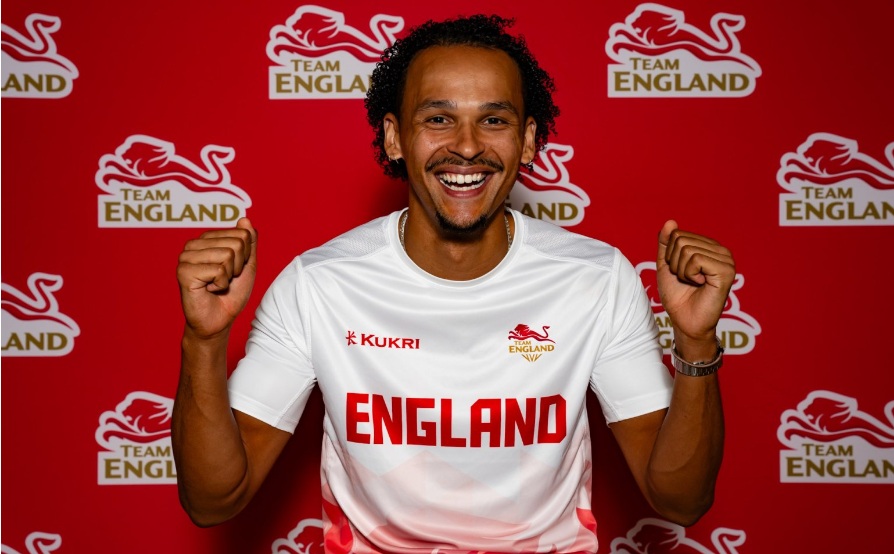
That creates an interesting proposition for sponsors. Athletes such as English sprint hurdler Sam Bennett (pictured) are already posting world class performances and are previous youth champions at international level.
Why spend millions securing a relationship with an established global superstar when it may be possible to support an athlete years earlier in their journey? The logic is remarkably similar to venture capital. Invest early. Back talent before everyone else recognises its value. Grow alongside it.
This is particularly attractive for insurers, wealth managers and banks, which increasingly prefer long-term partnerships that can evolve over many years rather than one-off sponsorship deals tied to a single event.
There is also a strong argument that the Commonwealth Games are uniquely aligned with modern corporate priorities. The themes repeatedly highlighted by sponsors include inclusion, accessibility, para sport, community participation, youth development, health and wellbeing, sustainability.
Glasgow 2026 has deliberately embedded many of these themes into the event’s structure, including its use of existing infrastructure and integrated Para-sport programme.
At a time when financial institutions are under increasing pressure to demonstrate social value, those attributes are commercially useful. A football sponsorship can provide visibility. A Commonwealth Games partnership can provide purpose.
ENDS