
There is a particular moment at any fintech conference when everything starts to blur together. The booths look the same. The language sounds the same. Every company promises speed, intelligence and security in roughly equal measure, usually wrapped in the same gradients and softly glowing interfaces.
In that environment, Middesk’s approach feels… different. Not dramatically so. You would not call it disruptive in the usual sense. But spend a little time with it and you begin to notice a certain intent, almost a quiet stubbornness about how it wants to be understood.
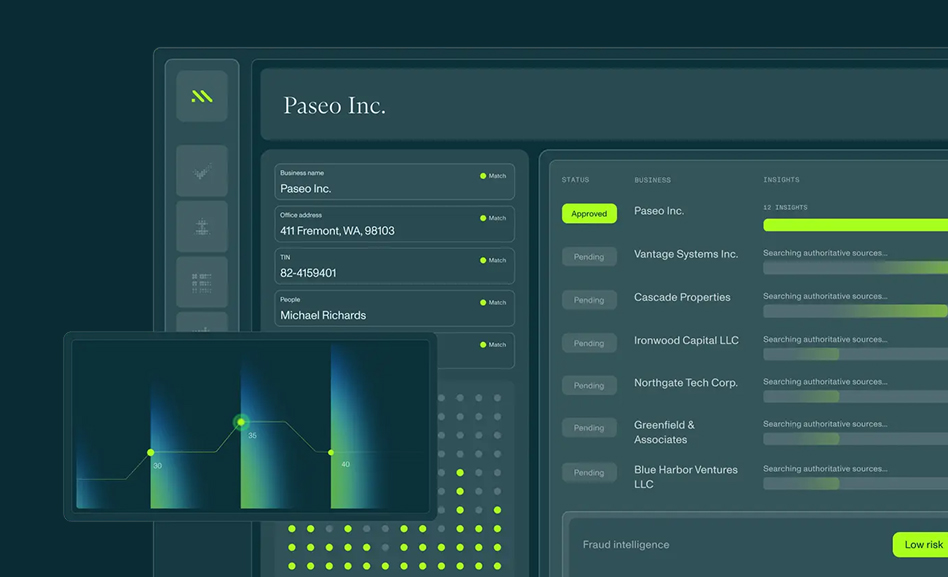
At its core, Middesk does something that is both essential and, historically, quite dull. It builds real-time identities for businesses by pulling together data from more than a hundred authoritative sources, allowing banks, lenders and fintech platforms to onboard customers quickly and with confidence.
That is infrastructure. It is not the sort of thing that usually inspires marketing teams. And yet Middesk has managed to turn it into a story that feels more consequential than the category it sits in.
Language shift
For years, the company sat comfortably in the KYB category. Know Your Business. Functional, accurate, and about as exciting as it sounds.
Then something changed. Not the product, necessarily, but the way it was framed. Middesk began talking instead about “business identity infrastructure”.
It is a small tweak on paper. In practice, it does a lot of work.
Wolff Olins has long made the point that the companies that shape markets are often the ones that redefine them. By moving away from KYB, Middesk is doing exactly that. It is stepping out of a category defined by compliance and into one that feels foundational.
You can almost hear the internal conversation. KYB is something you have to do. Infrastructure is something you build on.
That shift matters, particularly for a financial audience. Because once you stop thinking about identity verification as a regulatory hurdle, you start seeing it as something closer to a commercial lever.
Beyond back office
In most financial institutions, onboarding has historically been treated as plumbing. Necessary, yes, but not where value is created. The closer you get to revenue, the less patience there tends to be for anything that slows the process down. Middesk flips that logic. By speeding up access to reliable business data, sometimes as soon as it appears in state registries, it shortens the gap between a business existing and a business being banked.
That gap, as it turns out, is where a lot of opportunity leaks away. Ogilvy used to insist that good advertising should ultimately sell. Not entertain, not decorate, but sell. Middesk’s positioning sits squarely in that tradition. It is not really talking about data at all. It is talking about faster yeses. More approved customers. Fewer missed chances.
If you are a marketer, that lands differently. Suddenly onboarding is not just operations. It is conversion.
The look of love
If the strategy is thoughtful, the design choice is even more interesting. Most fintech brands today look like they were assembled from the same kit. Abstract visuals. Soft gradients. A kind of polite futurism that signals capability but rarely identity.
Middesk has gone the other way. Instead of trying to look like the future, it looks, in a very particular sense, like the present of regulated finance. Forms. Documents. Edges. Structure. The quiet geometry of paperwork. It sounds almost mundane. But that is the point.
Where others try to impress, Middesk tries to reassure. Saatchi & Saatchi’s old idea of “lovemarks” was about building emotional connections beyond reason. Middesk’s version is more restrained. It is not chasing affection. It is aiming for something closer to recognition. A feeling that this is familiar, credible, grounded in the way things actually work. And in a category where credibility is everything, that restraint feels quite deliberate.
Something technical
Of course, none of this works unless you can translate a very technical product into something that resonates.
This is where Middesk’s marketing becomes quietly clever.
Take its “Trust Club” campaign. On the surface, it looks like a fairly standard mix. A microsite. Some content. A bit of event activity. Paid media on LinkedIn.
But look again and you notice the framing.
Trust is not being presented as a feature. It is being treated as a shared concern, almost a common language between Middesk and its audience. By turning it into a “club”, the company gives people a way to engage with the idea socially, not just rationally.
It is a move that Byron Sharp would probably appreciate. You are not just communicating a message. You are building memory. Giving people a way to file the brand away so it is easier to recall later.
At the same time, the campaign never drifts too far from reality. There is always a line back to the practical problems. Poor data quality. Slow onboarding. Compliance friction.
The emotion is grounded. Which is why it works.
Built on discipline
There is, running through all of this, a sense of discipline that is worth calling out.
Middesk is not trying to do everything. It is not chasing every trend. It is not particularly loud.
And that, in a strange way, is what makes it stand out.
A lot of B2B marketing ends up as a kind of compromise. A strong idea diluted by layers of internal input until it becomes something safe but forgettable.
What Middesk seems to have done is the opposite. Start with a very clear belief. Trust enables commerce. Then build everything around that. The language. The design. The campaigns. It is almost old-fashioned in its clarity. Which is probably why it feels fresh.
Growth without the theatrics
There are, of course, numbers behind all of this. More than 600 customers. Significant funding. Expansion plans that now stretch beyond the US into EMEA. But the more interesting question is whether the thinking travels. Trust is a universal idea. But the way it is expressed can vary wildly across markets. What feels credible in one regulatory environment can feel unfamiliar in another. Middesk’s bet seems to be that by anchoring its brand in something fundamental, the mechanics of verification, the language of documentation, it has built something that can stretch.
Time will tell.
If there is a lesson here, it is not that every company should start talking about infrastructure or build a club around trust. It is something simpler. Be clearer about what you actually are. Not just what you do. Resist the temptation to look like everyone else, even if everyone else looks impressive.
And remember that in financial services, trust is not created by saying the word more often. It is created by making people feel, instinctively, that you understand the system they operate in.
Middesk has done that in a way that feels both understated and deliberate.
In a market full of noise, that is a harder trick than it looks.